The purpose of this blog
Saegusa
- 5 minutes read - 874 wordsToday, as I was browsing through Japanese Stack Exchange, I realized a lot of the material that was on this site was not really discussed anywhere else. This came as a bit of a surprise to me, because many contributors on the site had accumulated a lot of expertise on the finer points of Japanese language and were spending a lot of time answering questions.
The questions ranged from mundane translation requests to more complex inquiries that required extensive research and analysis, usually leading to a debate in the comments between well-known members of the communities, one citing Frellesvig, the other citing Vovin, everyone having a good time (or so I always assumed anyway).
I, too, had started to participate in the debates, albeit from a certain distance. Usually, I was asking questions rather than providing answers, but Voltaire once said to judge a man by his questions rather than by his answers, so you know. At the very least, I thought my questions were interesting enough.
A lot of them came from a project I had been working on for a good while now, an introduction to Japanese grammar for motivated students or fellow immersion-learning enthusiasts (for more on immersion-learning, see my website). This book would take the form of a rigorous yet approachable introduction to grammar for people who knew nothing more than kana and were willing to learn vocabulary using another resource.
And of course, the irony was not lost on me.
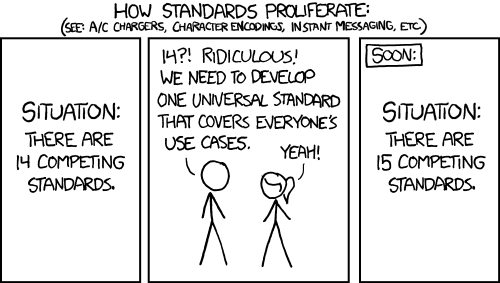
Must… write… one… more… book… — xkcd #927
Mind you, people had pulled the same comic on me when I had decided to make Kaishi 1.5k, so it wasn’t my first shot messing with core (hehe, get it) community resources. So why write yet another grammar book, anyway? There have been a plethora of resources available online (see the grammar section of the resource repository for a list of them), a lot of them free and accessible to everyone.
Unfortunately, a lot of these would take shortcuts in explaining grammar, sometimes leading to confusing, lacking or simply incorrect explanations. To be fair, many of these resources were written by people who were not native speakers of Japanese, and were not necessarily experts in the field. They were simply trying to help people learn the language. And for most people in the immersion-learning community, these resources were good enough.
Since most people emphasized the old Krashen motto that language is acquired, quality of the grammar explanations did not really matter, provided you read enough. But the hidden implication there was that beginners would not give up, they would simply persevere despite the shortcomings that these resources had and eventually get it, because they had read and listened to so much Japanese.
Now this was all good and well, but why was it then that some of the best Japanese learners I knew, those that had learned, breathed and lived immersion, were going back to learn grammar through monolingual resources? I do not have the answer, but what I do know is that most of them agreed that English resources on Japanese grammar were not quite fantastic, and that to truly “get it” you had to learn Japanese grammar in Japanese.
So I set out to read some of these books, and I found them fantastic as well. They didn’t cut corners. They explained concepts lucidly. They had fantastic example sentences that were not only accurate but also helped shed light on some of the more enigmatic parts of Japanese grammar, but they were written in Japanese. Why did we not have this in English? Were we doomed from the start?
To be fair, there was one resource written in English that gave me hope, IMABI. IMABI was written by a linguist, Seth Coonrod, and the explanations matched the credentials. This was a monster of a project, and one could immediately tell that Seth had poured hundreds and hundreds of hours into it. It covered everything from the ground up, even classical Japanese. So clearly, this was possible.
The only issue was that IMABI is absolutely huge. Seth tried his best to make it understandable by everyone, but the language was still technically difficult for most people, and the sheer size of it all (435 sections for modern Japanese at the time of writing) made it terrifying to beginners. Most people passed up on it because they were looking for something smaller, something more manageable.
Inspired by Seth, I decided to go back to the lecture notes I had a while back to tutor Japanese, and I decided to try writing something myself. This process has been ongoing, and the more I write, the more questions appear in my mind. Here are a few questions that have popped up so far:
- Where does だ come from?
- What is a な-adjective, really?
- Why can we use the た form for imperatives? (待った!)
- What is this weird ending that we see in things like ありがとう?
- Why is it that -ている can at times be used with completed events?
The purpose of this blog is to explore these stupid little questions, and figure out whether they deserve the adjectives “stupid” or “little”. At times, I might also post about other topics related to Japanese.